


AI in music and sampling: Will.i.am’s cautious stance
Explore Will.i.am’s cautious take on AI in music and sampling, highlighting credit for developers, fair payment, and evolving policy.
Will.i.am says he ‘can’t be that critical’ of AI in music because he has a career built on sampling. His view speaks directly to AI in music and sampling, and to how new tools echo old practices. He told CNBC at Davos that AI feels like an early era in music tech. Therefore, his stance blends curiosity with caution.
Because he sampled records for decades, he understands both creative reuse and rights issues. As a result, his comments raise urgent questions about credit, copyright, and payment. AI music generators learn from vast libraries of human work, and that training matters. However, developers who build algorithms also create art and deserve recognition.
We need balanced policy and industry practice to protect creators and encourage innovation. Looking ahead, he warned that in two decades AI may compose independently. Therefore, musicians, producers, labels, and lawmakers must prepare proactively.
This article examines those tensions and explains how technology, sampling culture, and copyright intersect.
The Development of AI in Music and Sampling
Will.i.am told CNBC at Davos that he “can’t be that critical” of AI because he built a career sampling music. His comments, reported by MusicTech (MusicTech), highlight the human and technical layers behind AI in music and sampling. He compared early AI to “Super Mario Bros.” before “Call of Duty,” which shows his view that the technology remains emergent. As a result, his interview frames both practice and principle for how we evaluate AI tools.
Developers build the algorithms that power AI music systems, and that work can be creative. Therefore, crediting those developers matters. They design models, curate training sets, and tune generation parameters. However, those models also learn from existing human art, which raises payment and copyright questions.
- Developer contributions: architects, engineers, and research artists who write code and choose model objectives.
- Training data: large music libraries, MIDI datasets, stems, and annotated metadata used to teach sound patterns.
- AI music generators: transformer models, generative adversarial networks, and diffusion systems that produce melodies, rhythms, and timbres.
- Creative process: prompt engineering, style conditioning, and human-in-the-loop editing that shape final tracks.
Technically, teams collect and preprocess audio, convert sound to symbolic or spectral representations, train neural networks, and then sample outputs. For example, models may learn harmonic progressions from jazz or rhythmic grooves from hip-hop. As Will.i.am warned, this training on yesterday’s music creates benefits and obligations. Therefore, industry practice must balance developer recognition with fair payment to the sources that trained these systems. Both the code and the creative corpus deserve transparent credit and licensing.
Ethical and copyright considerations
Training data and payment
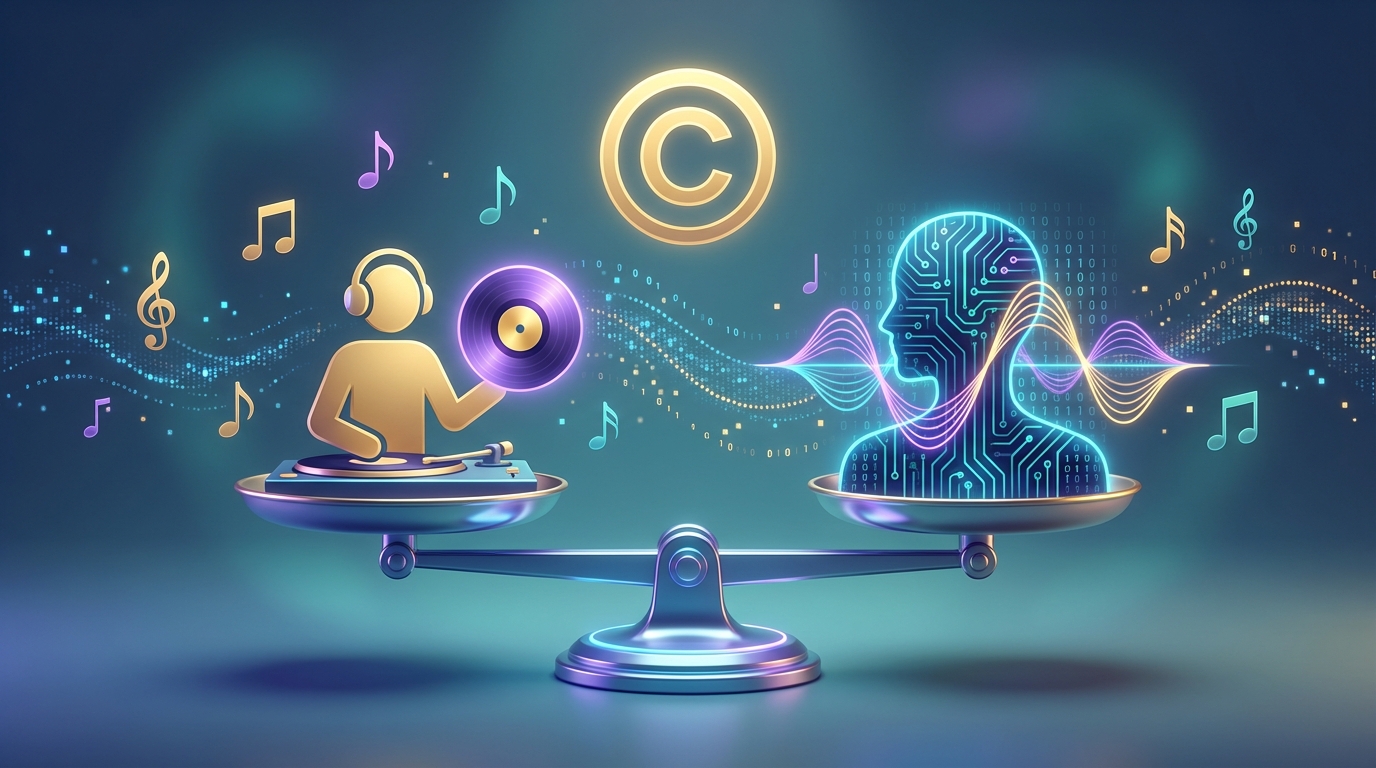
AI systems learn from existing music. As Will.i.am put it, “Yes, they did borrow from music. They did train on, you know, the entire library that humans have made and that people should be paid for…” Therefore, compensation for contributors matters. Platforms and developers must track dataset provenance and offer fair licensing. For context on international IP thinking, see the World Intellectual Property Organization’s guidance.
Credit for developers and creators
At the core of AI music sits a developer. Will.i.am argued, “At the core of AI music is some developer, and though that’s their art, you can’t discredit their art for creating that algorithm to create.” Consequently, we should credit developers and label their creative roles. However, credit for code does not replace payment for sampled source artists. Both deserve recognition and clear attribution policies.
Legal gray areas and policy responses
Copyright law often lags behind technology. As a result, courts and legislators face new questions about derivative works and training exemptions. Music industry coverage of Will.i.am’s Davos remarks explores these tensions in depth: MusicTech. Meanwhile, stakeholders should push for transparency in training datasets and practical licensing frameworks.
Preparing for future rights
Looking ahead, Will.i.am warned that future AI may create on its own. He said, “We’re going to get to a point 20 years from now where it would have evolved…” Therefore, creators, labels, and policy makers must prepare now. Adopt clear contracts, update collective licensing, and explore revenue-sharing models. In short, respect for original art and fair payment must guide AI in music and sampling as the field evolves.
Looking Ahead: AI’s Next 20 Years
Will.i.am warned that AI will move beyond imitation. He said, “We’re going to get to a point 20 years from now where it would have evolved, and it’s not about training on yesterday’s music.” Therefore, his forecast reframes AI in music and sampling as a long arc. For context on his Davos remarks see MusicTech.
From training on existing work to independent creativity
Today, most systems generate music by learning from human-made tracks. However, future models may develop internal creative heuristics. They could recombine ideas in novel ways without direct copies. As a result, legal and ethical definitions of authorship will blur. Consequently, stakeholders must revisit how they define originality and derivative work.
Industry impacts and creative change
Record labels, publishers, and streaming services will face new business models. Rights management systems must become more dynamic because ownership claims will multiply. Meanwhile, musicians could gain new tools for rapid prototyping and sound design. But artists will need clear revenue shares and rights protections to stay sustainable.
Preparing for transition
Policymakers should update laws and licensing frameworks. Developers should build provenance tracking into datasets. Creators should learn how to use AI responsibly. In short, prepare now for the shift from training-based models to autonomous creative systems. Only then can the music ecosystem balance innovation, credit, and fair payment as AI evolves.
Conclusion
Will.i.am’s position grounds the debate in lived practice. He said, “I can’t be that critical [of] AI, because I have a career sampling music…” His view reminds us that sampling and AI share lineage, and that both pose credit and payment questions.
Therefore, the path forward must balance innovation with respect for creators. Policymakers, labels, and developers should adopt transparent licensing, provenance tracking, and revenue-sharing models. Meanwhile, artists can use AI in music and sampling as a tool for experimentation, while also demanding fair compensation. If we act now, the industry can foster ethical progress and creative growth. In short, embrace technology but safeguard rights.
