


Open Source Eurorack Kits: Bastl Kastle 2 and Citadel
Explore Bastl Kastle 2 and Citadel DIY kits – open source Eurorack platforms, your hands-on path to Raspberry Pi powered synths, samplers, and effects.
Bastl Kastle 2 and Citadel DIY kits – open source Eurorack platforms: DIY synths, sample players and modular effects
Bastl Kastle 2 and Citadel DIY kits – open source Eurorack platforms put compact, Raspberry Pi-powered tools in builders’ hands. These kits let you build the Kastle 2 handheld multi-effect, sample player, or synth device. They also convert to Citadel Eurorack modules for seamless rack integration. Because Bastl is publishing much of the Raspberry Pi platform as open source, developers can inspect code. As a result, users can modify firmware, share patches, and fork hardware designs freely.
This openness encourages experimentation, collaboration, and rapid feature development across the modular community. Moreover, the DIY kits lower barriers for DIY synth builders and educators. Hobbyists get soldering practice, while professionals gain customizable tools for sound design and performance. The documentation and community patches help newcomers and labs adopt the platform quickly. Overall, Bastl’s move promises more creative choice for Eurorack, modular synthesis, and electronic music makers. Fans of Kastle, Citadel, and Raspberry Pi projects will find fertile ground.
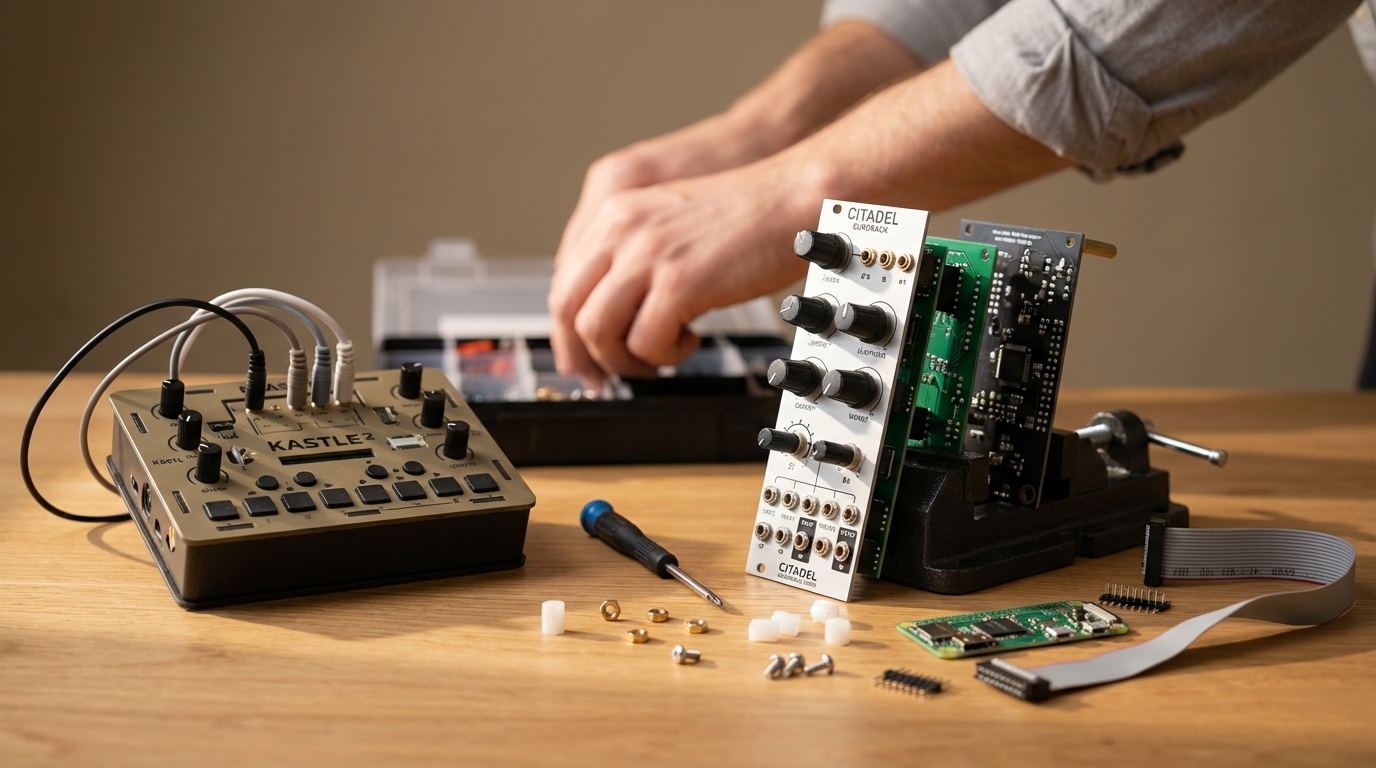
Technical features: Bastl Kastle 2 and Citadel DIY kits – open source Eurorack platforms
Bastl Kastle 2 and Citadel DIY kits marry compact hardware with flexible software. Because Bastl Instruments released large parts of the platform as open source, builders can explore both firmware and hardware. As a result, users gain deep control over sound, routing, and behavior. The designs run on Raspberry Pi-powered platforms and on optimized microcontrollers. Therefore, the kits balance processing power with small physical footprints.
Core hardware and build details
- Raspberry Pi compute and companion boards for heavy lifting, while lighter tasks use microcontrollers.
- Exposed PCBs and through-hole components for straightforward DIY assembly. This simplifies soldering and repairs.
- Standard Eurorack power headers on Citadel modules for direct rack integration.
- Compact Kastle 2 handheld enclosure with jacks and controls for immediate performance use.
These choices emphasize modularity and serviceability. Moreover, the open designs let labs and educators repurpose parts. For reference, Bastl maintains product information at Bastl Instruments and publishes code and designs at GitHub – Bastl Instruments. You can also learn about Raspberry Pi hardware used in similar projects at Raspberry Pi.
Software, open source elements, and Raspberry Pi-powered platforms
The software stack mixes open firmware and community patches. Therefore, developers can modify effects, sample handling, and synthesis engines. The Raspberry Pi-powered sections handle sample streaming and advanced DSP. Meanwhile, lower-level microcontroller code keeps latency low for live patching. Because the code is public, you can audit performance and adapt features quickly.
Multifunctionality: multi-effect, sample player, and synth
Kastle 2 modes
- Multi-effect mode offers delay, reverb, bitcrush, and filter chains.
- Sample player mode streams WAV samples from onboard storage.
- Synth mode runs small virtual analog or granular engines.
Citadel Eurorack equivalents
- The Citadel modules expose the same engines as modular units. They accept CV for modulation and gate control. Therefore, you can sequence, modulate, or process external sources easily.
Why this matters for builders and pros
Because both kits are open source, they accelerate experimentation. Hobbyists learn electronics and sound design faster. Professionals adapt modules for studio or stage use. As a result, the Bastl Kastle 2 and Citadel DIY kits become both learning tools and performance-grade devices.
| Feature | Kastle 2 handheld device | Citadel Eurorack module |
|---|---|---|
| Functionality | Acts as multi-effect, sample player, and synth. Small engines and effects run locally. | Offers the same multi-effect, sample player, and synth engines in Eurorack form. Accepts CV for deep modulation. |
| Usability | Designed for immediate play. Front-panel controls and jacks make live use easy. | Designed for rack use and patching. Panel controls and CV inputs support modular workflows. |
| Portability | Highly portable and battery-friendly. Therefore you can perform outside the studio. | Less portable due to rack mounting. However, it integrates into fixed rigs. |
| Target users | Hobbyists, educators, and performers who like hands-on devices. | Modular enthusiasts, studio pros, and experimental musicians needing rack integration. |
| Integration in modular setups | Can feed Eurorack via external converters, but needs adapters for full CV. | Native Eurorack integration with power headers, normalized patching, and CV control. |
| Build complexity | Beginner-friendly kit with through-hole parts and clear guides. As a result, it suits newcomers. | Medium complexity with Eurorack mechanics and connectors. Therefore some experience helps assembly. |
| Power and connectivity | Uses small power sources and common I/O jacks. Also supports USB for data. | Uses standard Eurorack power bus and many CV and audio jacks for routing. |
| Customization and open source | Firmware and parts include Raspberry Pi-powered sections and open source code. So you can modify and fork features. | Shares Raspberry Pi-powered elements and open designs. As a result, developers can adapt modules for custom rigs. |
Significance of Bastl Kastle 2 and Citadel DIY kits – open source Eurorack platforms
Bastl Instruments releasing Kastle 2 and Citadel as DIY kits marks an important shift. The move opens hardware and software to builders and performers. Because much of the platform runs on Raspberry Pi-powered elements, users can tap powerful sample streaming and DSP. As a result, developers can inspect, modify, and extend both firmware and hardware designs.
Open source and DIY culture deliver clear benefits to the modular community. Below are key advantages:
- Innovation accelerates because anyone can build on existing code and designs. This spurs new sounds and features.
- Customization becomes practical. Therefore you can tailor effects, sample players, and synth engines to your workflow.
- Community collaboration grows. For example, users share patches, panel layouts, and bug fixes on GitHub and forums.
- Accessibility improves, since DIY kits lower cost and teach electronics and synthesis quickly.
- Education and research gain hands-on tools. Thus universities and maker labs can adapt the platform for teaching.
- Repairability increases because open schematics reveal part choices and service points.
- Interoperability rises because open formats and CV mappings make Citadel modules easy to integrate.
For instance, Bastl Forums offer a space where enthusiasts contribute patch libraries and tutorials, exemplifying the spirit of collaborative growth. More community resources and discussions can be found on the Bastl Forum.
To see this in action, Bastl hosts public resources and example code at GitHub. Meanwhile, Bastl Instruments provides product details and guides at Bastl Instruments. The Raspberry Pi foundation pages at Raspberry Pi explain the compute modules used in these designs. These links help builders get started quickly and safely.
In practice, open kits let hobbyists fork new effects, and they let pros prototype stage-ready modules. Moreover, DIY culture builds communities that document hacks and performance techniques. Therefore Bastl’s open-source Kastle 2 and Citadel kits create a platform for shared creativity, long-term maintenance, and rapid experimentation across the Eurorack ecosystem.
CONCLUSION
