


Plug-and-play Multi Repetitor trigger module for live jams
Discover the Multi Repetitor trigger module: three banks, four outs, live tempo control for instant, knobs-friendly generative rhythms.
The Multi Repetitor trigger module leaps into modular rigs as a generative powerhouse for live performance and studio patching. Noise Engineering designed it to behave like a compact rhythm lab, and it already feels playful and precise. Because it blends algorithmic generation with hands-on control, the module suits improvisers and technical sound designers alike.
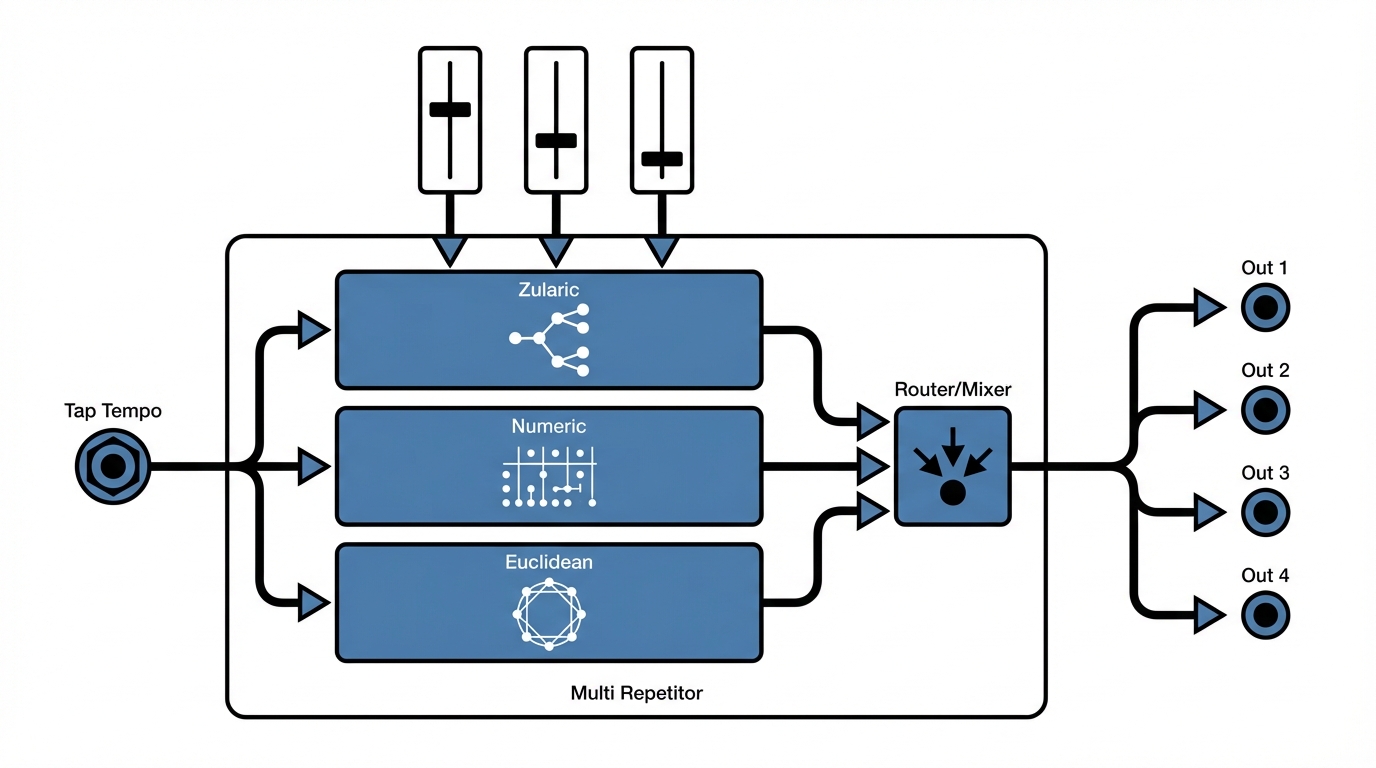
Under the hood you get three distinct banks: Zularic, Numeric, and Euclidean generators, each offering different rhythmic personalities. It also provides four trigger outs and dedicated performance faders for rapid live manipulation. Tap tempo and patch a cord, and you can instantly spin up percussive patterns you freely modulate. Therefore, you get both immediate musicality and deep experimental options.
This unit builds on Noise Engineering’s Numeric and Zularic Repetitor lineage, but it adds live performance transformations and streamlined playability. Because it aims to be plug-and-play, you can jump into jams without lengthy setup. However, it still rewards deep exploration later on. Read on to learn how this trigger module changes workflow and raises the bar for generative triggers in modular setups.
Core Features of the Multi Repetitor trigger module
The Multi Repetitor trigger module combines algorithmic generation with hands-on controls for fast, expressive rhythm creation. Because it builds on Noise Engineering’s Numeric and Zularic Repetitor designs, it feels familiar to existing users while adding new live performance features. For full specs and official details, see the manufacturer page: Noise Engineering Multi Repetitor.
Key features at a glance
- Three rhythm banks Zularic, Numeric, and Euclidean
- Zularic delivers complex, evolving trigger curves. Therefore, it suits experimental and glitchy patterns.
- Numeric focuses on mathematical sequences and tightly quantized pulses. As a result, it produces precise, algorithmic grooves.
- Euclidean spreads a chosen number of beats across steps to maximize evenness. For background on the method, see Toussaint’s paper: Toussaint’s Paper.
- Four trigger outputs
- Each output carries independent, configurable trigger streams. Thus, you can drive four drum voices or clock separate sequencers simultaneously.
- Outputs let you route accents, polyrhythms, or staggered hits across your rack.
- Dedicated performance faders
- The module includes faders for real-time shaping of density, swing, and probability. Because the controls are tactile, performers can morph patterns mid-set.
- Tap tempo and instant patch-based triggering
- Tap a tempo, patch a cord, and spin up percussive patterns immediately. This plug-and-play workflow makes the unit ideal for improvisation and live jams.
Why this matters for live rigs
The Multi Repetitor trigger module blends generative algorithmic triggers with immediate performance tools. Therefore, it shortens setup time and increases improvisational flexibility.
Visual suggestions
- Close-up of hands adjusting faders on the module during a live jam.
- Wide shot of an Eurorack case with four patch cables going to drum modules on stage.
- Macro photo of the trigger outputs with blinking LEDs and a performer tapping tempo.

Evolution and Lineage of the Multi Repetitor trigger module
Noise Engineering did not invent generative triggers overnight. Instead, the Multi Repetitor trigger module grows directly from two earlier designs. The Numeric Repetitor emphasized mathematical, tightly quantized pulses. The Zularic Repetitor favored evolving, asymmetric grooves. Both pushed algorithmic generative triggers into Eurorack systems.
Because the company learned from those modules, the Multi Repetitor expands live performance features. It combines Numeric and Zularic ideas and adds a Euclidean bank for even-distribution patterns. Therefore, you get three banks in one module, which increases creative range without extra panels. The unit also adds four trigger outputs and dedicated performance faders. As a result, performers can route multiple drum voices and morph patterns in real time.
Key improvements over predecessors
- Unified banks together Numeric, Zularic, and Euclidean generators into a single workflow
- Four independently routable trigger outputs for complex polyrhythms and accents
- Performance faders for density, swing, and probability control during shows
- Tap tempo and immediate patch-based triggering for plug-and-play live jams
Peter Kirn captured the shift well in his coverage, noting “Tap a tempo, patch a cord, and instantly spin up percussive patterns you can freely modulate — the best of what the company gave us before, but now with live performance transformations and more possibilities.” The article ran on 2026-01-22. He added that the design is meant to be immediate, writing “I also like that they imagined this to be plug-and-play, so you can get going and tweak by ear without advance prep.”
For official module details see Noise Engineering’s pages for the Multi Repetitor Multi Repetitor, Numeric Repetitor Numeric Repetitor, and Zularic Repetitor Zularic Repetitor.
Practical Uses in Live Performance and Modular Setups
The Multi Repetitor trigger module shines when you need instant rhythm ideas on stage. Because it is plug-and-play, you can start a set in seconds. Tap a tempo, patch a cord, and the module will deliver evolving percussive patterns you can shape live. Therefore, it suits improvisers, live jammers, and studio performers who want algorithmic generation without fuss.
Begin simple then go deep
- Start with one bank and a single trigger out. As a result, you get a usable rhythm instantly.
- Add a second bank to create counter-rhythms or accents. Next, route separate outputs to different drum voices.
- Engage all three banks to produce layered polyrhythms. Then use faders to morph density and swing in real time.
Why performers love it
- Fast setup because tap tempo and patch-based triggering remove menu diving.
- Hands-on control with dedicated performance faders for density, swing, and probability.
- Four independent trigger outs let you assign sounds to drums, envelopes, and sequencers.
- Algorithmic variety thanks to Zularic, Numeric, and Euclidean banks for both precise and evolving grooves.
How to use it on stage
Patch a trigger out to a drum module and set a tempo. Then nudge faders to add swing or randomness. Because the outputs are independent, you can send a steady kick to one voice and a glitchy Zularic pattern to another. As a result, your rhythm section becomes a dynamic, playable instrument.
Further reading and resources
For official specs and workflow notes see Noise Engineering’s product page here and background on Euclidean rhythms at Toussaint’s paper here.
Key advantages at a glance
- Instant, plug-and-play generative triggers for live jams
- Flexible routing with four trigger outs for complex setups
- Tactile performance faders for expressive, on-the-fly changes
- Scales from simple one-output patterns to deep modular modulation
The Multi Repetitor trigger module condenses three powerful generators into a single, playable unit. It brings Zularic, Numeric, and Euclidean engines to your rack. Because it includes four trigger outs and tactile performance faders, it routes complex polyrhythms with simple patches.
Technically, it blends algorithmic generative triggers with hands-on control. As a result, you can tap tempo, patch a cord, and begin improvising immediately. Additionally, the plug-and-play design reduces setup time for live jams. Moreover, dedicated faders let you morph density, swing, and probability in real time.
For performers, the benefits are clear and practical. You get immediate percussive patterns and deep modulation paths later. Therefore, whether you want a steady kick or glitchy Zularic chaos, the unit delivers. Finally, explore it on stage, in the studio, or as part of a hybrid setup. And yes, it might make your rhythms sound smarter than your drummer—lightly.
